
 Deutsch
 English
 Chinese

Advancing Global Climate Governance and Deepening Sino-German Cooperation in Science and Technology
VCAC President Professor Michael Zhengmeng Hou Delivers a Keynote at the Sino-German Symposium on Climate Change
On 27 October 2026, the Sino-German Symposium on Climate Change was held at the China Hall of Science and Technology. The event was organised by the Department of International Cooperation of China’s Ministry of Science and Technology. Vice Minister Guangjun Zhang delivered a video address, and Jia Zhuang, Deputy Director-General of the Department of International Cooperation, chaired the meeting. Experts and scholars from China and Germany discussed global climate governance, the transition to net zero, and cooperation on green and low-carbon development.
Prof. Dr.-Ing. Michael Zhengmeng Hou, President of the Chinese Alumni Association of TU Clausthal (VCAC) and a tenured professor at TU Clausthal, was invited to deliver a keynote. He also serves as a Co-founding Editor-in-Chief of Carbon Neutral Systems (CNS) and chairs the Committee on Carbon Neutrality and Energy Transition of the China (Germany) R&D and Innovation Alliance (CFEID). His presentation was entitled “The Global Climate Responsibility and Resilience Fund (GCRRF) and Sino-German Collaborative Innovation in 4CUS Carbon-Negative Technology”. Linking institutional innovation in climate governance with demonstrations of carbon-negative technology, the presentation formed an important part of the symposium’s discussions on Sino-German collaborative innovation.
The five other keynote speakers were Nianzhi Jiao, Member of the Chinese Academy of Sciences; Kebin He, Member of the Chinese Academy of Engineering; and Deliang Chen, Foreign Member of the Chinese Academy of Sciences. They were joined by Otthein Herzog, Foreign Member of the Chinese Academy of Engineering and Member of acatech, the German National Academy of Science and Engineering, and Ferdi Schüth, Member of the German National Academy of Sciences Leopoldina.
Their presentations addressed marine negative emissions, the transition to net zero, frontiers in global climate science, AI-assisted climate risk identification, and the phase-out of fossil resources in industry. Together, they presented recent advances in climate change research in China and Germany.
Looking Ahead to COP31 with Proposals for Climate Governance and Carbon-Negative Technology
Looking ahead to the 31st United Nations Climate Change Conference (COP31), Professor Hou presented a comprehensive proposal for the Global Climate Responsibility and Resilience Fund (GCRRF). The proposal covers contribution obligations, priorities for assistance, the use of funds, open procurement, governance and oversight, and mechanisms to ensure compliance. It aims to establish an implementation framework with quantifiable responsibilities, prioritised needs, competitive procurement, auditable implementation and sustainable capacity. Professor Hou also proposed voluntary pilot programmes and independent evaluations to deepen cooperation between China, Germany and the European Union in climate governance.
Turning to technological innovation, Professor Hou introduced the 4CUS carbon-negative technology that his team is developing. The approach uses depleted oil and gas reservoirs as natural subsurface biochemical reactors. Microorganisms convert industrial CO₂ and hydrogen-bearing by-product gases into methane. By combining renewable natural gas production, underground storage and the sequestration of residual CO₂, the technology offers a new pathway for converting industrial waste gases into resources and establishing a circular carbon–energy system. The team has already produced a body of research and is actively advancing demonstration projects in China and international cooperation.
Professor Hou’s keynote presented his research on global climate governance and carbon-negative technology. It also reflected the commitment of VCAC alumni to academic exchange and Sino-German cooperation in science and technology.
Looking ahead, VCAC will continue to serve as a bridge, supporting alumni in academic research, international exchange, and the transfer and application of research results. By further advancing Sino-German cooperation on green and low-carbon technologies, the association will contribute the knowledge and experience of its alumni to the global response to climate change.
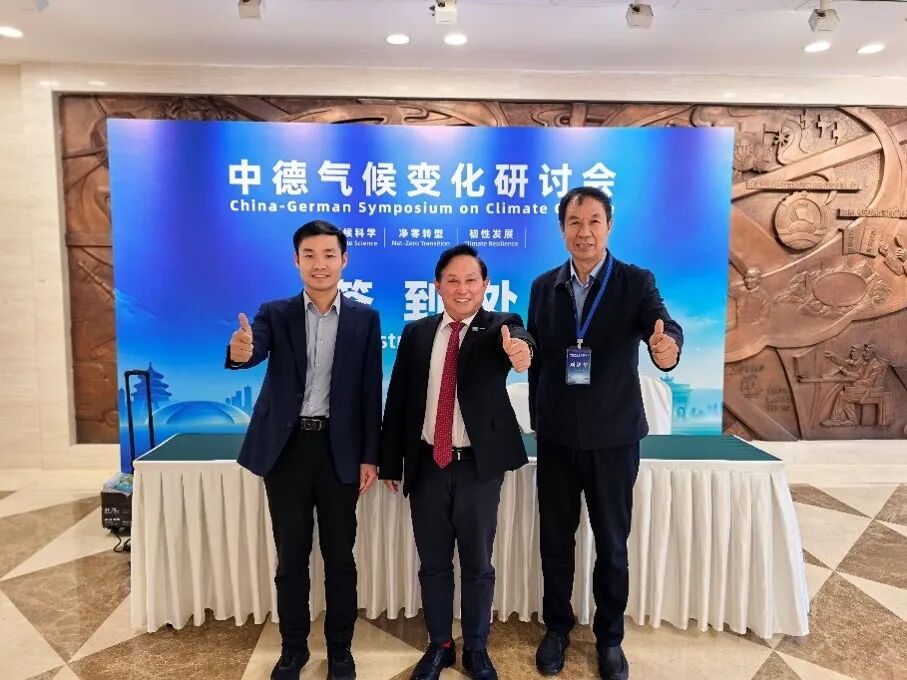
Participating alumni representatives at the Sino-German Symposium on Climate Change
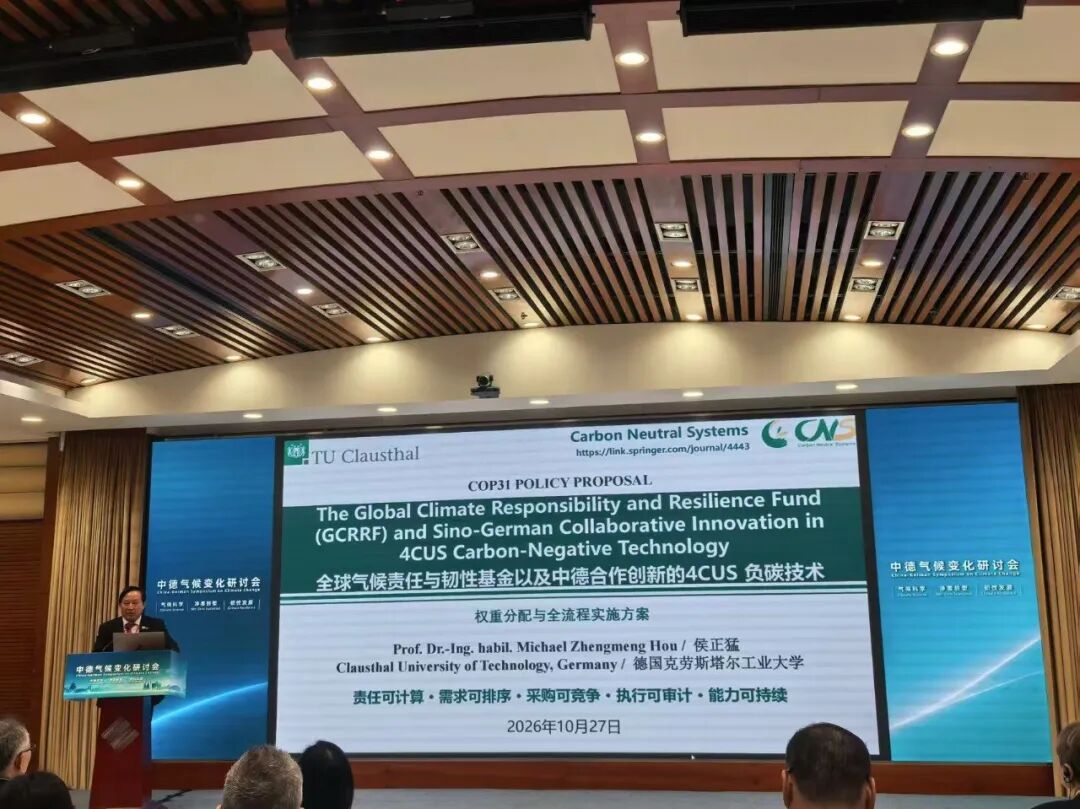
Professor Michael Zhengmeng Hou delivers his keynote at the Sino-German Symposium on Climate Change
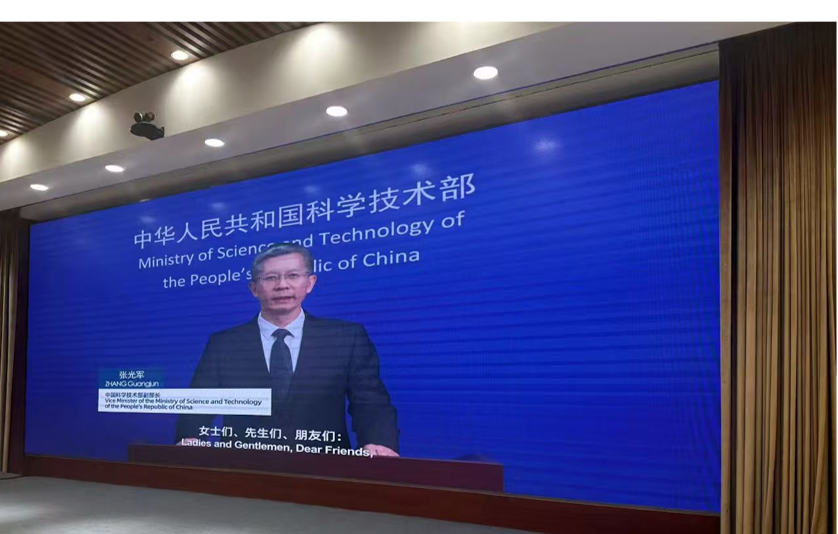
Vice Minister Guangjun Zhang delivers a video address
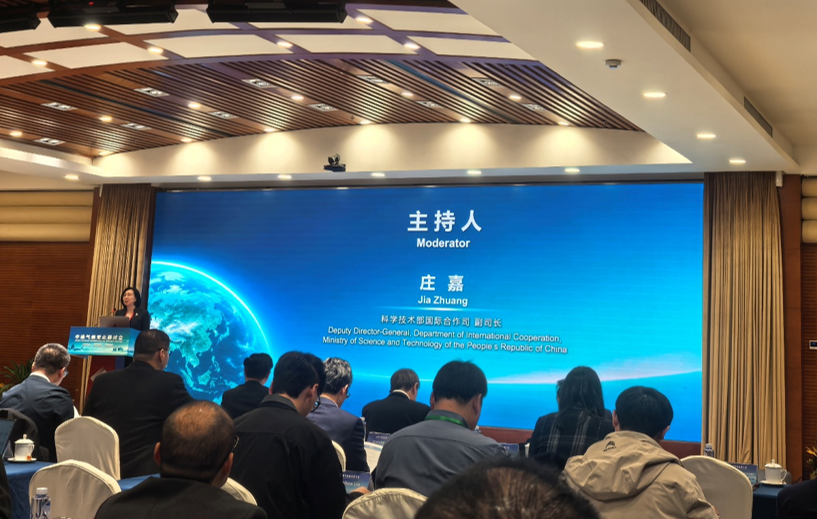
Jia Zhuang, Deputy Director-General of the Department of International Cooperation, chairs the symposium