Deutsch
 English
 Chinese

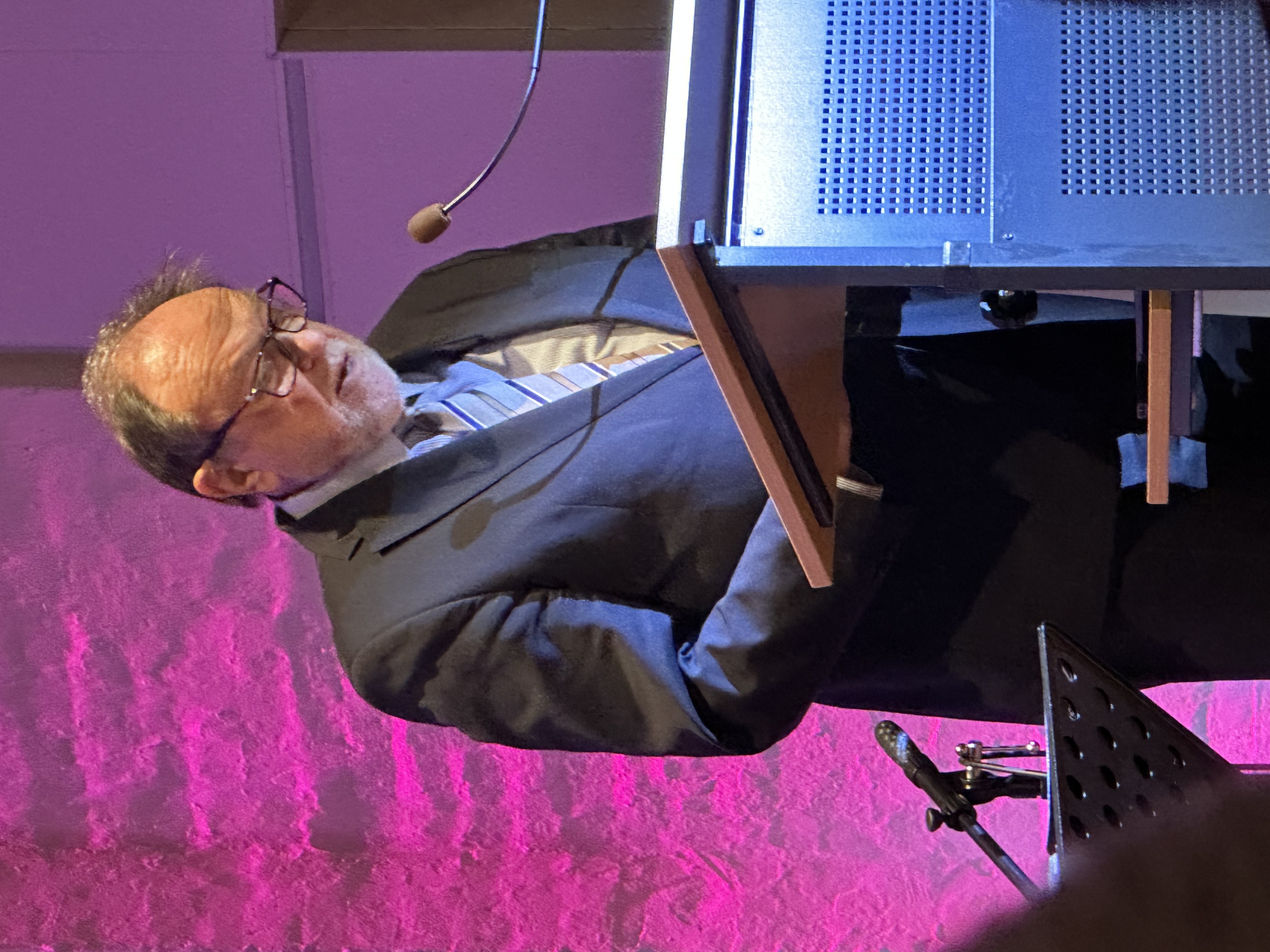
Greeting Remarks on the Occasion of the New Year Reception of the Leibniz Confucius Institute Hannover on 17 January 2026
In his New Year reception address at the Leibniz Confucius Institute Hannover, Prof. Dr. Thomas Hanschke reflects on more than two decades of German–Chinese exchange and cooperation. Drawing on personal experiences from academic partnerships, official visits and cultural encounters, he highlights the growing global significance of China and calls for stronger China competence in Germany. Emphasising “cooperation with heart” built on optimism, sovereignty and mutual respect, he advocates for continuing and deepening the strong ties between Lower Saxony and China—especially in higher education and cultural exchange.
Good evening, ladies and gentlemen, dear students!
My experiences with the People’s Republic of China go back to the year 2004. At that time, I was Vice President for Academic Affairs and Teaching at Clausthal University of Technology and was involved in the internationalisation of the university. In this work I have been actively accompanied until today by my colleague Professor Michael Zhengmeng Hou, who is also among us. With humility and gratitude I look back on a wonderful period of German-Chinese friendship. Unforgettable is the reception at the German Embassy in Beijing in 2008 with our then Minister-President Christian Wulff and the many presidents and vice presidents of Chinese universities, all of whom studied in Clausthal. This also includes my appearance in front of thousands of students in the football stadium of the East China University of Science and Technology in Shanghai, where I had been positioned in the honorary stand next to high-ranking members of the Communist Party and the military, or the joint bicycle tour with my wife on the city wall of Xi’an on the occasion of a visit to Yue Delong, the vice president of the Chinese Academy of Engineering. I was particularly impressed by the conversation with Zhang Dejiang, at that time Vice Premier of the People’s Republic of China, who unexpectedly turned out to be an excellent connoisseur of Clausthal University of Technology.
I would like to briefly tell you about that: a large black limousine picks me up from the hotel. Inside sits Mr Davidson, head of department of the Lower Saxony State Chancellery. “Where are we going, Mr Davidson?” “We are going to the Vice Premier of the People’s Republic of China.” “But where are the others?” I ask, seeking help. “The Vice Premier only wants to speak with you and the Minister-President.” “What is it about?” “It is about German energy policy.” “But I don’t understand enough about that.” “That doesn’t matter. You have to get through this now!” But I didn’t have to say anything at all. Because Zhang Dejiang gave a passionate lecture about Clausthal University of Technology and how excellently it is positioned in the German-Chinese context. And our Minister-President’s eyes shone bright and clear.
My guiding figure in German-Chinese relations is Professor Wan Gang, former rector of Tongji University and Minister of Science and Technology of the People’s Republic of China. Mr Wan Gang earned his doctorate at Clausthal University of Technology and worked for Audi for ten years before returning to China. He wishes for “cooperations with heart” and appeals to us to approach our relations with optimism, sovereignty and respect.
After a period of restraint, caused by the pandemic, a China strategy of the federal government that was intonated somewhat pessimistically, an inappropriately low media echo regarding the anniversary year of German-Chinese relations, and a very heated discussion about the dual-use issue in research, German-Chinese relations have fortunately gained momentum again.
Because in the last decade, the economic and political weights in our world have noticeably shifted from West to East. The People’s Republic of China plays a central role in this, not only assuming a pioneering role politically and economically, but increasingly also technologically.
Due to China’s strong interweaving into the international division of labour, China’s further development is of central importance for the entire world and not least for Germany, as Stefan Baron writes in his book The Chinese. The Expert Commission on Research and Innovation (EFI) of the federal government therefore consequently states: “Germany needs more China competence.”
I undertook my inaugural trip as China representative of the Lower Saxony Ministry for Science and Culture in 2019. This trip left a lasting impression on all participants. Because for the first time we had not only science but also culture with us. We were accompanied by an instrumental ensemble from HarzClassixFestival and Jieni Wan, concert pianist and daughter of Professor Wan Gang. We were somewhere else every day. In the morning we devoted ourselves to scientific exchange, in the evening we made music together. The trip crossed the line of the Yellow River several times, cradle of Chinese civilisation and symbol of the spirit and cohesion of the Chinese people – a wonderful ambience for interpersonal communication and emotional closeness.
We need China as a partner in order to advance ourselves. VW still makes a large part of its turnover in China. And with Bosch and Continental it will soon not be much different.
But China also needs us. Not only as an outstanding trading partner and reliable partner in joint ventures, but also as a place of education. Many well-known Chinese representatives of business and science studied in Germany. The share of Chinese students in Germany amounts to 11% of the total number of foreign students; in Lower Saxony it is currently even almost 20%.
When my parents used to think of China, they may possibly have associated their ideas with Franz Lehár’s operetta The Land of Smiles, which offers us the exotic pentatonic music of China in a late-romantic European context. The title song “Yours Is My Heart” does not hint at the tragic end of the plot. Because the love between Lisa, the daughter of an Austrian count, and the Chinese prince Sou-Chong breaks apart due to the incompatibility of their characters. But today, 100 years after its premiere, Lehár’s operetta has become obsolete as a metaphor for the emotional relationship between China and Europe. Because with pride we look—especially in Lower Saxony—back on many stable, long-standing relationships between Lower Saxon and Chinese universities, shaped by respect and harmony. And in the meantime, within the framework of our numerous winter and summer schools, many new life partnerships between East and West have even begun.
I will work to ensure that it continues like this!
Prof. Dr. Thomas Hanschke, former Commissioner of the Lower Saxony Ministry for Science and Culture for university cooperation between Lower Saxony and China