Deutsch
 English
 Chinese

Hannover Messe 2026 — Prof. Thomas Hanschke, on New Opportunities for China-Germany Cooperation
At Hannover Messe 2026, former President of Clausthal University of Technology, Professor Thomas Hanschke, highlighted new opportunities for China-Germany cooperation. He emphasized that the future of bilateral relations lies in mutual understanding, technological innovation, and talent exchange. Amid global industrial transformation, both sides still share vast potential in education, research, and industry collaboration.
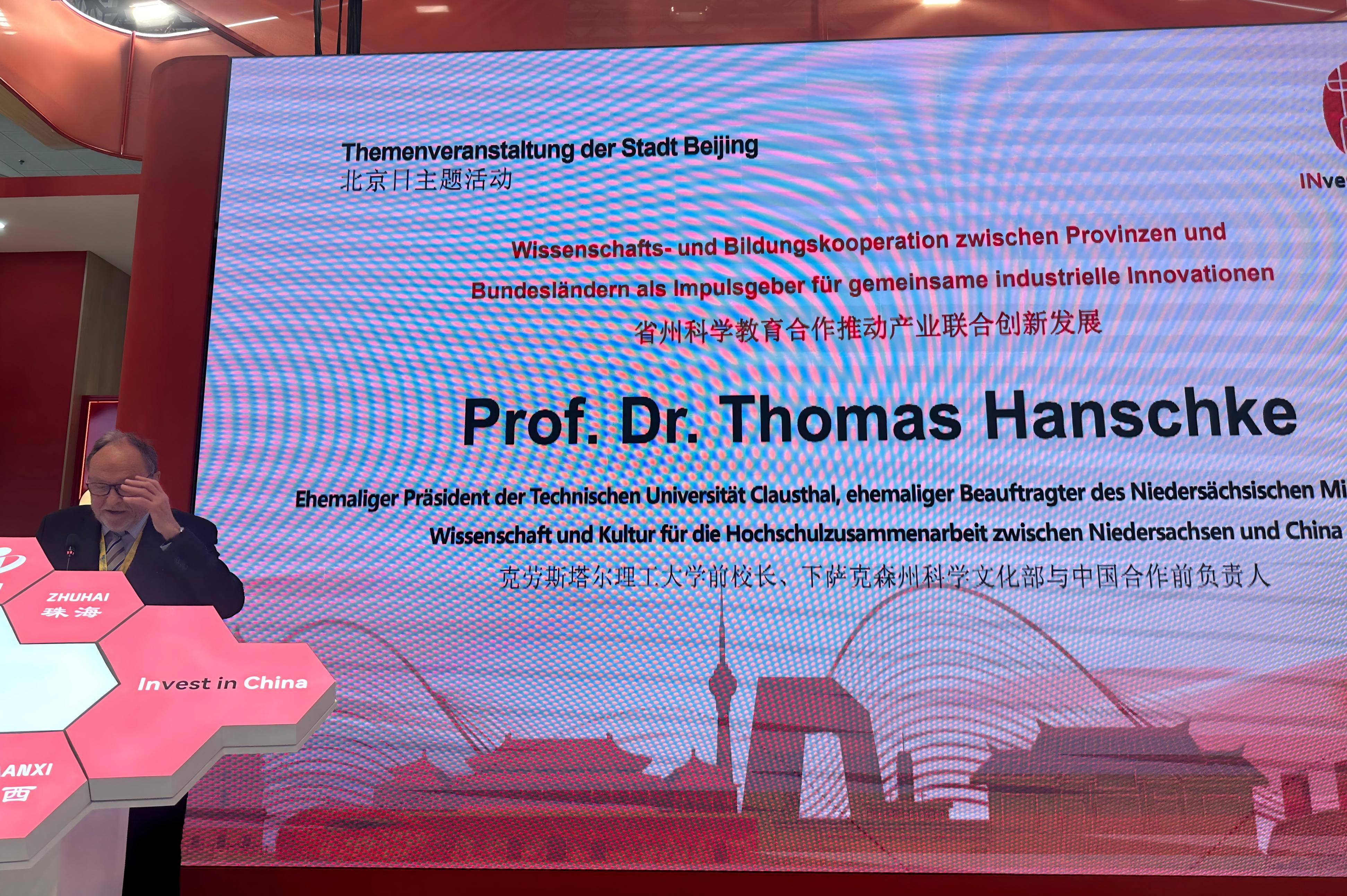
On the afternoon of April 21, the “Invest in China – Beijing Two Zones Promotion Event” was successfully held at the Invest in China exhibition area (Hall 11 D70) during Hannover Messe. The event was organized by the China International Investment Promotion Agency (Germany) and co-organized by the China (Germany) R&D and Innovation Alliance. The program focused on the opening-up and cooperation opportunities of Beijing’s “Two Zones,” as well as technological innovation and industrial exchange. During the event, Professor Thomas Hanschke, former President of Clausthal University of Technology and former Head of China Cooperation Affairs at the Ministry of Science and Culture of Lower Saxony, delivered a keynote speech titled:
“Regional Scientific and Educational Cooperation Driving Joint Industrial Innovation.”
Reflecting on his long-standing exchanges with China, Professor Hanschke emphasized that China-Germany relations should be viewed with optimism, mutual respect, and pragmatism. He also called for deeper cooperation in science, education, and industrial collaboration.
A Strong Emotional Foundation Built Through Long-Term Exchange
Professor Hanschke recalled the founding of the China (Germany) R&D and Innovation Alliance ten years ago in Berlin, inaugurated personally by then Chinese Minister of Science and Technology Wan Gang—also a distinguished alumnus of Clausthal University of Technology. He shared his many years of continuous exchanges with Chinese universities, research institutions, and innovation platforms, and how these experiences gradually deepened his understanding of China.
In his view, China-Germany cooperation has never been an abstract concept. It is the result of countless visits, exchanges, reunions, and practical joint efforts over the years. Despite changes in the international environment, he said he remains confident in the future of China-Germany friendship and cooperation. This confidence comes not only from the solid foundation built over many years, but also from his long-term observation of China’s development path and innovative capacity. He stressed that truly resilient international cooperation must be built on long-term trust, understanding, and mutual respect.
Germany Needs China — and China Needs Germany
Professor Hanschke pointed out that China remains one of Germany’s most important economic and trade partners. China has demonstrated rapid progress and strong innovation capacity in areas such as steel manufacturing, artificial intelligence, and electric vehicles, continuously strengthening its position in the global industrial and technological landscape. In his view, China’s development is no longer simply about manufacturing growth, but increasingly about technology leadership and innovation-driven progress. He noted that China’s speed of development and execution capability have deeply impressed him. Whether through the constantly evolving skyline of Shanghai or the organizational efficiency behind major infrastructure projects, he sees clear evidence of China’s determination to advance modernization and innovation.
At the same time, he emphasized that China also needs Germany. Germany is not only a reliable trade and cooperation partner, but also offers unique strengths in higher education, research training, engineering systems, and international talent development. Many outstanding Chinese entrepreneurs and scholars studied and grew professionally in Germany. This two-way exchange and mutual success form an important cornerstone of bilateral cooperation.
Professor Zhengmeng Hou — A Bridge Between China and Germany
Professor Hanschke paid special tribute to his colleague and friend, Professor Zhengmeng Hou of Clausthal University of Technology, saying: “The door to China was opened for me by Professor Hou.” In his view, Professor Hou is not only an academic partner, but also an important guide who helped him gain a deeper understanding of China and engage in China-Germany cooperation. Although the international situation continues to change, Professor Hanschke said this door to China has never closed. His sincere remarks reminded the audience that sustainable cooperation depends not only on policies and platforms, but also on individuals like Professor Hou—people who truly understand both cultures and build bridges of trust over the long term.
Real Cooperation Requires Deeper Understanding
Professor Hanschke also highlighted a key concept: “China Competence.” Citing relevant studies, he noted that successful scientific and economic cooperation with China requires much more than language skills. It also demands an understanding of China’s cultural background, institutional environment, policy logic, and social dynamics. Only with such comprehensive knowledge can cooperation become deeper, more stable, and more sustainable. He observed that while Germany still has room to strengthen its understanding of China, China’s understanding of Germany is often more developed. For this reason, he welcomed Germany’s growing attention to building “China Competence,” while noting that academic resources in this field still do not fully match China’s importance in today’s global landscape. For international cooperation today, the decisive factor is not merely whether projects or platforms exist, but whether enough people truly understand each other and can continue building bridges across education, research, industry, and society.
China Is Becoming a Major Innovation Force
In the second half of his speech, Professor Hanschke further shared his observations on China’s technological development. He made it clear that China is no longer simply the traditional “world’s factory,” but has become an increasingly important technology leader and innovation driver in many fields. “Created by China” is becoming an ever clearer label. He cited several development cases that have impressed the international community, demonstrating China’s continuous breakthroughs in artificial intelligence, major engineering projects, and frontier technologies. In his view, these achievements are no coincidence—they are built on long-term investment, systematic organization, and clear strategic goals. For this reason, he said the international community should view China’s development with openness and foresight, and seek more opportunities for cooperation and shared success. He concluded with a concise and powerful message: “Think Tech Forward in Partnerschaft mit China!” This was both his observation and his proposal: to think about future technological development while discovering new possibilities through partnership with China.
Starting from Hannover, Expanding Future Cooperation
As a global barometer of industrial technology, Hannover Messe is not only an important platform for showcasing the latest innovations, but also a key window into trends in international industrial cooperation. The “Invest in China – Beijing Two Zones Promotion Event” held on April 21 demonstrated Beijing’s commitment to openness, cooperation, and innovation through policy presentations, keynote sharing, and business exchange.
Amid global technological transformation and industrial restructuring, China and Germany still have broad opportunities for cooperation in science, education, industry, and talent development. As Professor Thomas Hanschke conveyed in his speech: Only by building trust through understanding, and facing the future through cooperation, can we truly seize the new opportunities brought by innovation-driven development.