Deutsch
 English
 Chinese

From Europe’s Heatwaves to Global Climate Responsibility: Prof. Dr.-Ing. habil. Michael Zhengmeng Hou Proposes a New Institutional Framework for the “Global Climate Responsibility and Resilience Fund (GCRRF)” Ahead of COP31
Interview with Prof. Dr.-Ing. habil. Michael Zhengmeng Hou
Professor at Clausthal University of Technology, Co-Founding Editor-in-Chief of Carbon Neutral Systems
Commemorating the First Anniversary of Carbon Neutral Systems (CNS)
Interview conducted and compiled by: Tianle Shi
Editor’s Note
As Carbon Neutral Systems marks the first anniversary of the launch, the journal is entering a new stage in its mission to advance interdisciplinary dialogue on carbon neutrality, energy transition, climate resilience, and sustainable development. To commemorate this milestone, this special interview with Prof. Dr.-Ing. habil. Michael Zhengmeng Hou, Co-Founding Editor-in-Chief of Carbon Neutral Systems, looks beyond individual technologies and national pathways to one of the defining questions of the carbon-neutral transition: how global climate responsibility can be translated into an equitable, operational, and accountable institutional framework.
In the summer of 2026, Europe was once again thrust into the global spotlight by extreme climate anomalies. According to data released by the World Meteorological Organization (WMO), France recorded a national average temperature of 30.0°C on June 24, with temperatures in parts of western France soaring to an unprecedented 43.8°C. Simultaneously, red heat alerts blanketed multiple European regions, triggering school closures, severe grid stress, and intensified public health crises. The Copernicus Climate Change Service (C3S) confirmed that western Europe experienced its warmest June on record in 2026, with average temperatures surging approximately 3°C above the 1991–2020 baseline.
Extreme heatwaves are no longer merely "uncomfortable" weather anomalies; they have escalated into critical public health emergencies that directly threaten human life and safety. During this period, Santé publique France observed a striking spike in all-cause mortality, exceeding 1,200 deaths on June 24, and surpassing 1,400 daily deaths on June 25 and 26. Reuters reported over 4,700 excess deaths across France, Belgium, Spain, and the Netherlands during the June heatwave. Subsequent epidemiological assessments by Germany’s Robert Koch Institute (RKI) indicated that approximately 5,120 heat-related fatalities were recorded nationwide in 2026, with the vast majority concentrated in late June.
Climate change is rapidly evolving from an abstract scientific and environmental discourse into an immediate crisis intersecting public health, economic loss, energy security, and global governance. At COP29 in 2024, Parties adopted the New Collective Quantified Goal on Climate Finance (NCQG), setting a target of mobilizing at least USD 300 billion per year by 2035, with Developed country Parties taking the lead, while urging collective action to scale up global climate finance from public and private sources to at least USD 1.3 trillion annually. COP30 in 2025 further advanced the Baku-Belém 1.3 trillion Roadmap, adaptation finance, and the broader implementation agenda.
However, the global community still lacks operational, legally rigorous institutional arrangements to govern how responsibility should be shared among nations, how financing should be mobilized annually, how recipient projects should be prioritized, and how competitive procurement and oversight should function in practice. Against this backdrop, and as part of the first-anniversary reflections of Carbon Neutral Systems, this interview presents Prof. Hou’s proposal for a Global Climate Responsibility and Resilience Fund (GCRRF) ahead of COP31, focusing on how historical responsibility, present-day capacity, climate vulnerability, market mechanisms, and institutional accountability can be integrated into an operational global framework.
1. Europe’s Heatwaves Are More Than Weather News: They Are a Warning for Global Climate Governance
Question: Dear Prof. Hou, this year’s extreme heat across Europe has drawn global concern, severely impacting France, Germany, Belgium, the Netherlands, and Spain. Why do you believe these heatwaves should not be viewed as isolated meteorological anomalies, but must instead be addressed within the broader architecture of global climate governance?
Prof. Hou: The profound significance of the recent European heatwave is that it demonstrates that climate change is no longer a distant, abstract ecological projection. It has aggressively entered the daily lives of citizens, directly straining healthcare systems, elderly care facilities, urban power grids, agricultural output, and public fiscal reserves.
Historically, when discussing climate change, the public imagination gravitated toward melting glaciers, rising sea levels, or stranded polar bears—perceiving it as a remote crisis. Europe's current reality proves that climate change impacts human society first and foremost. Extreme temperatures drastically elevate the risks of cardiovascular and cerebrovascular events, respiratory distress, and severe heatstroke. These conditions are exceptionally hazardous for the elderly, individuals with chronic illnesses, marginalized outdoor laborers, and low-income demographics. France is a highly developed nation with a resilient healthcare system and advanced urban governance; yet, its systems were severely strained, resulting in significant excess mortality. This indicates that climate risks have officially breached the comfort zone of conventional public management.
Furthermore, Europe represents a core cradle of modern industrial civilization and one of the earliest regions to industrialize. Today, Europe itself is grappling with severe heat, systemic droughts, catastrophic wildfires, and public health emergencies driven by climate change. This shifts the paradigm: climate finance is no longer a unidirectional mechanism of "developed nations aiding developing nations." It has transformed into a universal governance challenge that the entire global community must confront collectively, albeit through differentiated responsibilities.
Therefore, the critical insight from Europe's heatwave is that global climate governance has reached a historical tipping point: it must transition from "moral advocacy" to "concrete institutional design." We can no longer merely reiterate calls to reduce emissions, scale up aid, and strengthen multilateral cooperation. We must decisively answer operational questions: Who pays? How much do they contribute? Who receives the funds? How are they deployed? Who exercises oversight? And what are the institutional consequences of non-compliance?
2. France Is a Representative Case of Europe’s Heatwaves, but the Problem Extends Far Beyond France
Question: In recent deliberations, data from France have attracted significant analysis. How do you view France’s representativeness within the wider European climate crisis?
Prof. Hou: France is highly representative, yet our analytical lens must encompass the entire continent. France serves as a critical baseline for several structural reasons.
First, France carries the institutional memory of the catastrophic 2003 European heatwave, which caused tragic loss of life across the continent. In its aftermath, France pioneered sophisticated heat-warning networks, overhauled nursing home protocols, and institutionalized emergency healthcare preparedness. Despite these deep-seated institutional resources, the 2026 heatwave still drove up mortality risks. This offers a sobering lesson: even with extensive experience, robust contingency frameworks, and substantial fiscal assets, established social infrastructure can still be overwhelmed by the accelerating frequency and intensity of extreme climate events.
Second, France possesses a highly diversified geographic and demographic landscape—spanning hyper-urbanized metropolises like Paris, vital agricultural belts, vulnerable coastal zones, and specialized inland communities. Consequently, the shock of extreme heat is systemic rather than isolated, simultaneously disrupting urban heat islands, aging demographics, nuclear power cooling water availability, agricultural irrigation networks, occupational safety, and public health.
Third, France’s vulnerability mirrors the structural vulnerabilities of Europe as a whole. Germany is confronting parallel heat-induced health shocks and spikes in mortality; southern European nations like Spain and Italy face chronic, compounding pressures from heatwaves, structural droughts, and wildfires; while low-lying, densely populated nations like Belgium and the Netherlands face severe compound risks.
In essence, France acts as an analytical window revealing the rising climate vulnerability across the European continent. However, scientific rigor requires an important caveat: we cannot simplistically declare that an individual nation's localized heatwave is exclusively caused by its own territorial emissions. The global climate system is interconnected; greenhouse gases mix uniformly in the atmosphere. Europe’s heatwaves are the localized manifestation of global warming intersecting with regional atmospheric circulation, urban heat island effects, diminished soil moisture, and specialized energy infrastructure. Our scientific communication must remain impeccably precise.
3. A Single Heatwave Cannot Be Equated with Climate Change, but Increasing Frequency Has a Clear Climate Background
Question: Skeptics frequently argue that a single localized heatwave cannot serve as definitive proof of systemic climate change. What is your scientific perspective on this argument?
Prof. Hou: As an isolated statement, that premise is scientifically accurate, but presenting it without long-term context creates a profound misunderstanding. A single heatwave undoubtedly possesses immediate, localized meteorological drivers—such as anomalous atmospheric circulation, stagnant high-pressure systems, specific sea-surface temperature patterns, and urban heat island effects. However, when analyzed through a longitudinal macroeconomic and environmental lens, the statistical probability, physical intensity, and duration of these extreme events are steadily climbing, aligning perfectly with the overarching trajectory of global warming.
I frequently employ a maritime analogy: weather represents the daily fluctuations of localized waves, whereas climate represents the systemic sea level. You cannot claim that an individual wave is determined exclusively by the sea level. However, if the overall sea level rises significantly, those exact same waves become structurally empowered to overtop established seawalls. Global warming has elevated the baseline temperature of the planet, causing previously rare, extreme thermal thresholds to be breached with increasing ease.
The recurring nature of unprecedented heatwaves in Europe over recent years indicates that the continent’s climate-risk thresholds have fundamentally shifted. Temperatures once classified as centennial anomalies are transforming into seasonal baselines. Public infrastructure and healthcare systems constructed under historical assumptions must now be radically redesigned. This reality underscores the urgent necessity of robust climate adaptation and execution-oriented climate finance.
4. Historical Cumulative Emissions Must Also Be Considered Climate Responsibility Cannot Be Based Only on Today’s Emissions: Historical Cumulative Emissions Must Also Be Considered
Question: In shifting the dialogue from localized crises to global governance architecture, you consistently emphasize the primacy of historical cumulative emissions. Why is this metric so foundational to equity?
Prof. Hou: Because carbon dioxide does not dissipate the day after it is emitted; it possesses a multi-century atmospheric lifetime and a long-term cumulative effect. Anthropogenic global warming is not determined by emissions generated within a single fiscal year, an isolated quarter, or a specific modern industrial cycle. It is the physical consequence of continuous, long-term cumulative emissions since the dawn of the Industrial Revolution in 1775.
Focusing exclusively on current annual emissions is analytically equivalent to looking only at who is actively running a tap into a massive swimming pool today. It completely ignores the fact that the water level in that pool has been rising for over two centuries. Now that the water level is reaching critical capacity and threatening to overflow, it is fundamentally inequitable to penalize the actor currently using the tap while absolving those who filled the bulk of the volume over the long term.
For responsibility allocation and accounting, I strongly recommend establishing 1775 as the common, unified baseline year for historical cumulative emissions. Under this methodology, both historical cumulative national emissions and historical cumulative per capita emissions must be computed using standardized, traceable data spanning from 1775 to the latest available reporting year. This framework incorporates emissions from the early stages of modern industrialization into a single carbon ledger, comprehensively reflecting long-term carbon space consumption. Individual country rankings and subsequent financial obligations should be strictly recalculated based on this unified methodology when a formal global assessment is executed.
My position is clear: Historical cumulative national emissions and historical cumulative per capita emissions, calculated uniformly from the 1775 baseline, must serve as a primary pillar in allocating financial responsibility within global climate funds.
5. Historical Responsibility Alone Is Not Enough: Current Per Capita Emissions and Capacity to Pay Must Also Be Included
Question: If responsibility were allocated solely through the lens of historical cumulative emissions, wouldn't that overlook nations with high current per capita emissions and the rapidly growing carbon footprints of major emerging economies?
Prof. Hou: Exactly, which is why I do not advocate for a unidimensional historical total approach. A resilient and politically viable climate responsibility framework must simultaneously evaluate four pillars: historical cumulative totals, historical per capita equity, recent per capita emissions, and real capacity to pay.
Historical cumulative totals identify who historically occupied the vast majority of the global carbon space; historical per capita emissions safeguard individual human equity by evaluating average carbon consumption per capita over time; recent per capita emissions pinpoint which societies continue to maintain high-energy, high-consumption, and high-emission lifestyles today; and capacity to pay evaluates which economies possess the actual fiscal and macroeconomic capacity to shoulder substantial financial obligations.
Only by dynamically synthesizing these four pillars can we faithfully operationalize the foundational principle of Common but Differentiated Responsibilities and Respective Capabilities (CBDR-RC) enshrined in the UNFCCC.
Failing to do so allows two unconstructive extremes to stall multilateral negotiations. On one hand, certain developed nations attempt to entirely dismiss their historical carbon debt, insisting on looking exclusively at current aggregate emissions. On the other hand, some nations with exceptionally high current per capita emissions shield themselves behind a generic "developing country" status, evading financial contributions commensurate with their actual income and consumption brackets. Neither extreme serves global progress. Institutional design must transcend political slogans; responsibility must be translated into a mathematical matrix of indicators that are transparently calculated, publicly disclosed, and rigorously audited.
Otherwise, two extremes may emerge. One is that developed countries completely deny their historical responsibility and insist on looking only at current total emissions. The other is that some countries with high current per capita emissions hide entirely behind their status as developing countries and avoid assuming responsibilities commensurate with their income and consumption levels. Neither approach helps solve the problem.
Therefore, institutional design must avoid devolving into mere slogans. Responsibility needs to be translated into a system of indicators that are quantifiable, disclosable, and auditable.
6. From COP29 and COP30 to COP31: Why Is a New Climate Finance Framework Still Needed?
Question: COP29 was widely termed the "Finance COP," and COP30 in Belém, Brazil, aimed to accelerate the finance, adaptation, and implementation agendas. What substantive milestones did these summits achieve, and why do you argue they still fell short of resolving the structural questions of global climate finance—namely, who pays, how much they pay, who receives it, and how it is deployed?
Prof. Hou: We must evaluate COP29 and COP30 with strict objectivity. It would be factually incorrect to characterize them as failures. The crowning achievement of COP29 was the formalization of the New Collective Quantified Goal (NCQG). Under this framework, Developed country Parties committed to taking the lead in mobilizing at least USD 300 billion annually by 2035 to support climate action in developing countries, while simultaneously calling for a broader scaling of global climate finance from diverse public and private streams to at least USD 1.3 trillion per year by 2035.
It is critical to clarify a frequent point of confusion: the USD 300 billion figure is a target formalized for achievement by the year 2035. It was never structured as a mandatory annual disbursement starting immediately in 2025 or 2026. Therefore, claiming that "the international community has already missed the USD 300 billion target for consecutive years" is factually inaccurate. A precise diagnostic assessment is that global governance is currently in the early phase of scaling financial volumes and engineering the necessary implementation protocols.
However, a 2035 target date does not justify complacency regarding the current deployment gap. According to official comparable data released by the Organisation for Economic Co-operation and Development (OECD) in May 2026, developed economies provided and mobilized USD 132.8 billion in climate finance for developing nations in 2023, and USD 136.7 billion in 2024. Using 2024 as a benchmark, current mobilization stands at a mere 46% of the USD 300 billion NCQG target, leaving an annual deficit of approximately USD 163.3 billion. Furthermore, the historical USD 100 billion annual goal originally targeted for 2020 was achieved for the first time only in 2022—a two-year delay. This highlights a chronic vulnerability in international climate politics: commitments are fast-tracked, while physical delivery lags severely.
The quality of capital is equally concerning. In 2024, sovereign loans constituted approximately 67% of public climate finance, while direct grants accounted for a mere 29%. Total adaptation finance reached roughly USD 34.7 billion in 2024, but its annual growth rate between 2022 and 2024 stagnated at approximately USD 1 billion per year. For developing nations already suffocating under high sovereign debt distress, restricted fiscal space, and compounding climate disasters, adding premium-rate debt under the guise of "climate support" does not offer affordable relief. In fact, it risks actively converting environmental vulnerability into severe sovereign debt crises.
The structural limitation of COP29 was not its failure to generate a headline number, but its failure to translate that macro-target into an explicit responsibility allocation schedule and a binding payment schedule. While the USD 300 billion can legally originate from public coffers, private capital markets, or Multilateral Development Banks (MDBs), there remains an institutional void defining how alternative financial instruments are accounted for, which loans or guarantees qualify, how much each major economy is obligated to contribute, and what the baseline milestones are year-by-year. With the official collective progress tracking mandated to commence via biennial reporting only in 2028, the critical initial years face a severe deficit of standardized, comparable oversight.
COP30 pushed the needle forward by advancing the implementation mechanics of the Baku-Belém 1.3 Trillion Roadmap and reaffirming global financing pathways. It called for tripling adaptation finance by 2035, launched a two-year Climate Finance Work Programme, and adopted the Belém Adaptation Indicators to quantitatively measure progress toward the Global Goal on Adaptation (GGA). These steps are highly meaningful, reflecting an acknowledgment that financing scale, physical adaptation, and domestic implementation capacity must progress in tandem.
Yet, from an operational standpoint, COP30 left the most complex, politically sensitive questions unanswered: What is the exact financial obligation of each major responsible economy? Is there a mandatory, progressive year-by-year scale-up pathway? How do we rigidly separate public funding from commercial private investments? What minimum percentage must consist of non-repayable grants and concessional instruments? Which specific nations and high-vulnerability projects receive priority? How is global procurement insulated from geopolitical corruption? Who holds final executive authority over fund allocation, who implements the infrastructure, who audits the outcomes, and what formal enforcement mechanisms apply to persistent payment shortfalls? The roadmap offers a directional compass, but it does not provide an immediately executable global responsibility schedule or a functional project pipeline.
Therefore, while COP29 and COP30 laid vital foundations, critical institutional gaps remain in execution: we have a financial target, but no individual payment schedule; we have a macro-roadmap, but no progressive annual implementation matrix; we have high-level commitments, but no unified framework for recipient prioritization, competitive open procurement, transparent auditing, or non-compliance enforcement. What international climate governance lacks today is not another ambitious headline figure; it lacks the institutional architecture required to translate numbers into capital, capital into projects, and projects into verifiable ecological outcomes.
To address this challenge ahead of COP31, I propose the establishment of the Global Climate Responsibility and Resilience Fund (GCRRF) under the formal framework of the UNFCCC. The GCRRF is not envisioned as another conventional, passive aid ledger. Instead, it is designed as a complete institutional loop engineered to solve the execution deadlocks that left previous summits incomplete:
- The Contribution Side (Weighting Algorithm): Individual financial obligations are determined via a rigorous algorithm factoring in historical cumulative national emissions since 1775, historical cumulative per capita emissions since 1775, recent consumption-adjusted per capita emissions, and real capacity to pay.
- The Recipient Side (Vulnerability-Based Ranking): Allocation priorities are mathematically scaled based on quantified indicators of economic and social losses, sea-level exposure, and low-elevation coastal vulnerability.
- The Implementation Side (Global Open Competitive Tendering): Recipient nation infrastructure packages, green products, physical works, and expert services compete directly on a unified, transparent platform, optimizing for optimal life-cycle cost and overall performance.
- The Oversight Side (Transparent Auditing): Every single capital transaction, project milestone, procurement award, and performance metrics is publicly disclosed and subject to strict independent technical verification and financial auditing.
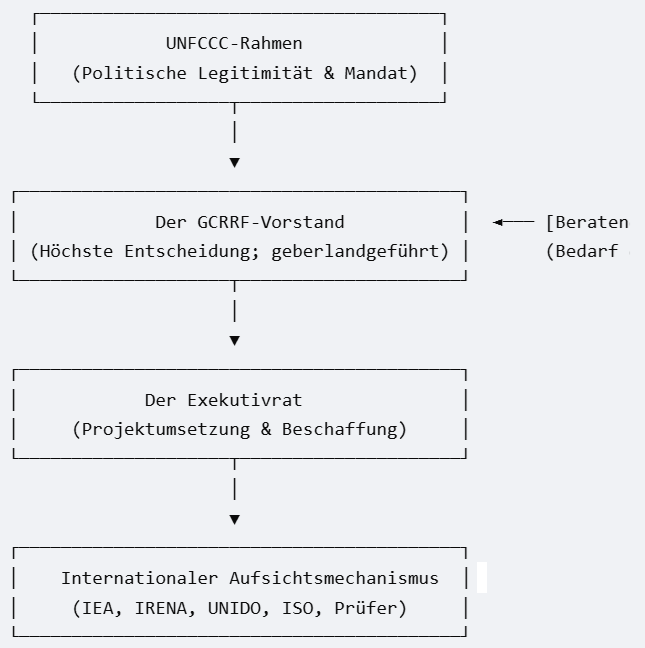
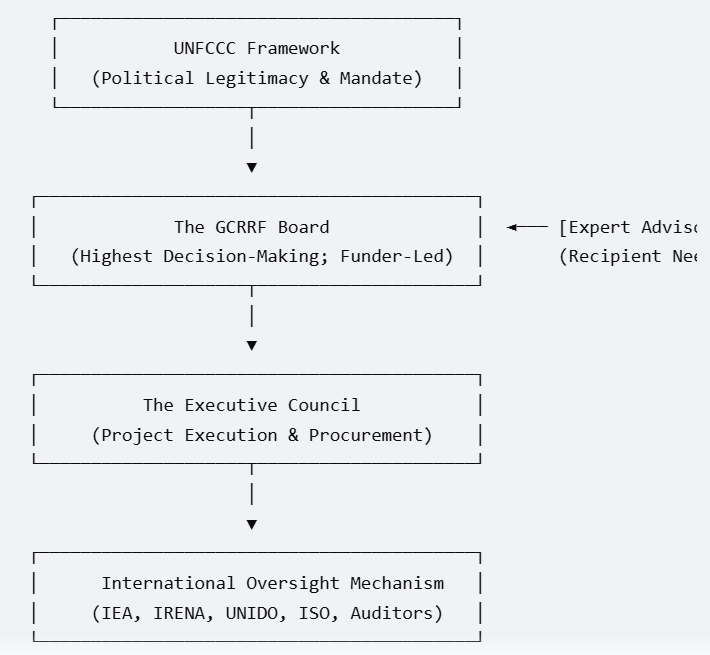
- The Governance Side (Layered Authority): A contributor-led Board maintains supreme decision-making authority over macro-budgets; an Executive Council drives day-to-day project execution; premier international institutions (IEA, IRENA, UNIDO, ISO) and independent auditors spearhead continuous verification; and recipient nations voice localized demands via an Expert Advisory Committee.
This framework is not designed to duplicate or replace the Green Climate Fund (GCF), the Loss and Damage Fund (LDF), or established MDBs. Its precise mandate is to act as an institutional bridge connecting responsibility calculation, recipient prioritization, open procurement, layered governance, and compliance accountability—systematically transforming macro-commitments into an executable, monitorable, and fully assessable global project system.
7. Contribution Weights: How Should the Four Responsibility Indicators Be Weighted?
Question: Structurally, how would the mathematical algorithm function to calculate each contributing nation's precise financial allocation?
Prof. Hou: Following extensive consultative modeling, I recommend a balanced four-factor formula:
- Historical cumulative national emissions since 1775: 35%
- Historical cumulative per capita emissions since 1775: 35%
- Consumption-adjusted per capita emissions over the most recent five years: 15%
- Capacity to pay: 15%
Together, these weights equal 100%. This four-factor weighting architecture is operationalized as follows:
First, historical cumulative national emissions responsibility (35%), calculated uniformly from the 1775 baseline, anchors macro-historical accountability. Industrial superpowers like the United States, major European industrial nations, Russia, Japan, Canada, and Australia carry naturally high baselines under this indicator.
Second, historical cumulative per capita emissions responsibility (35%), also scaled from 1775, guarantees individual human equity. Nations such as Canada, the United States, Australia, the United Kingdom, Germany, Belgium, and select Nordic countries have historically maintained disproportionately high cumulative per capita footprints. This indicator ensures that highly populated developing nations are not unjustly penalized with massive aggregate financial burdens simply due to their large population baselines.
Third, consumption-adjusted per capita emissions over the most recent five years (15%) introduces a critical accounting correction. In our globalized economy, multiple post-industrial nations have outsourced heavy manufacturing offshore, artificially lowering their domestic production-based emissions while continuing to import and consume vast quantities of carbon-intensive commodities. Conversely, nations like China, South Korea, Taiwan, China, and key Southeast Asian manufacturing hubs bear massive production-side carbon accounting, while the finished commodities are heavily consumed in Western markets. Therefore, recent emissions profiles must account for carbon embodied in international trade, rather than relying solely on localized production territory.
Fourth, capacity to pay (15%) integrates real-world macroeconomic strength. Sovereign states with high gross national income, high-income resource-exporting economies, and powerful financial centers are obligated to guarantee stable, predictable capital injections. Conversely, Least Developed Countries (LDCs), Small Island Developing States (SIDS), and low-income, hyper-vulnerable nations are explicitly exempted from cash contribution mandates.
Expressed as a functional equation:
100% contribution responsibility = 35% historical national emissions + 35% historical per capita emissions + 15% recent consumption-adjusted per capita emissions + 15% capacity to pay
The core advantage of this model is its structural equilibrium: the two historical pillars combine for a dominant 70% weighting, ensuring that historical carbon debt remains the primary driver while cleanly balancing national totals with per capita equity. The remaining 30% is split equally between recent trade-adjusted consumption and real capacity to pay, successfully integrating contemporary responsibility and real fiscal feasibility into a politically viable framework.
8. Approach Contributing Countries Should Be Differentiated by Category Rather Than Treated with a One-Size-Fits-All Approach
Question: Which specific sovereign states and economic blocs would become the primary funders under this paradigm, and how do you classify them to avoid an inflexible, one-size-fits-all approach?
Prof. Hou: A modern global governance mechanism must reject binary, rigid country lists in favor of a dynamic, layered classification system. I recommend organizing contributing economies into four clear categories:
Category I: Core Historical Responsibility Economies
This tier comprises the sovereign states that have continuously occupied the lion's share of the global carbon space throughout their industrialization since 1775, resulting in exceptionally high historical cumulative totals alongside high historical per capita emissions. Prominent examples include the United States, major industrial member states of the European Union, the United Kingdom, Japan, Canada, Australia, and Russia. The United States occupies a uniquely critical position within this tier, as it ranks at the absolute zenith of both historical national totals and long-term per capita accumulation.
Category II: High-Income, Resource-Based High-Emitting Economies
These nations are not necessarily traditional manufacturing or post-industrial superpowers, but they currently exhibit extremely high per capita emissions profiles paired with substantial financial capacity. This category prominently includes high-income oil and gas exporting states such as Qatar, the United Arab Emirates, Kuwait, Saudi Arabia, Bahrain, and Oman, alongside parallel resource-rich high-income economies. Having generated substantial long-term national wealth from fossil fuel extraction and exports, these nations must assume funding obligations commensurate with their contemporary income levels and per capita footprints.
Category III: High-Income, High-Consumption Developed Economies
This tier targets advanced economies characterized by deeply entrenched, high-carbon lifestyles and infrastructure. Examples include the United States, Canada, Australia, New Zealand, select European nations, Japan, and South Korea. While several of these nations have initiated active domestic decarbonization pathways, their underlying social structures—spanning housing sizes, private transportation dependency, high-energy heating/cooling systems, and consumer behavior—maintain high per capita carbon footprints. Even if their historical cumulative totals do not rank at the very top, their modern per capita consumption and advanced capacity to pay generate a robust financial obligation.
Category IV: Differentiated Contributors Among Major Emerging Developing Economies
This vital tier encompasses major contemporary emitters within the developing world, including China, India, Brazil, Indonesia, South Africa, Mexico, and abandonment-era transitional economies like Türkiye. While their current aggregate emission volumes are significant, their developmental baselines, massive population structures, historical per capita accumulation, and capacity to pay are radically distinct from Category I developed nations. Consequently, their participation must not simply mirror the rigid mandatory financial obligations of post-industrial states. Instead, their quantified contributions should be operationalized flexibly through a diversified matrix: including cash capital injections, highly concessional financing facilities, the provision of state-of-the-art green technology and equipment at preferential rates, large-scale engineering and construction execution, localized technical training networks, and robust South-South climate cooperation frameworks.
This architecture accurately operationalizes the true intent of "common but differentiated." "Common" dictates that no major global economy can remain outside the systemic ledger; "Differentiated" guarantees that historical carbon debt, human equity, contemporary development baselines, and fiscal capacity are never artificially erased.
9. Why Is This Model Fairer to China?
Question: Geopolitical analysts will inevitably scrutinize how this model impacts China, given its status as the world’s leading contemporary emitter. How does your framework accurately recognize China’s global responsibility while actively protecting it from inequitable, politically motivated burdens?
Prof. Hou: China, as a major global power and an influential contemporary economy, undoubtedly bears an undeniable responsibility to actively co-anchor global climate governance; it cannot and does not claim exemption. However, assigning climate funding obligations to China based strictly on raw, contemporary annual territorial emissions is profoundly unscientific, historically inaccurate, and structurally inequitable.
My framework evaluates China through three objective, structural realities:
First, when establishing the unified global baseline of 1775, China's historical cumulative per capita emissions remain remarkably low when placed in direct, head-to-head同口径 comparison with long-industrialized superpowers like the United States, Canada, Australia, the United Kingdom, and Germany. Evaluating responsibility without long-term tracking violates basic equity.
Second, a substantial portion of China's contemporary emissions profile is deeply linked to the international division of labor and global manufacturing supply chains. China operates as the undisputed "world's factory," generating vast volumes of embedded carbon to manufacture commodities exported globally. It is structurally unjust for European and American societies to consume these high-carbon products to support their lifestyles while shifting the entire associated carbon accounting onto China's domestic production ledger.
Third, China possesses unparalleled, hyper-competitive structural advantages in green industrial technology and manufacturing. This spans solar photovoltaics, advanced energy storage, electric mobility solutions, smart microgrids, high-voltage electrical equipment, and rapid infrastructure engineering. The IEA explicitly notes that China's manufacturing capacity commands over 80% of the global supply chain across every critical stage of solar PV production.
Consequently, if a global climate fund institutionalizes a transparent, technology-neutral competitive tendering process optimized for optimal life-cycle costs and technical reliability, Chinese enterprises will naturally secure a substantial share of contract awards based on pure market efficiency and industrial merit. This does not represent an artificial geopolitical preference for China; it is the logical outcome of industrial capability and market dynamics.
Thus, within the GCRRF framework, China’s global role is successfully elevated from a one-dimensional "funder under pressure" into a dynamic, composite role: acting simultaneously as a responsible contributor, a premier green technology provider, a master engineering contractor, and a powerful catalyst for localized capacity building across the Global South.
10. How Should Recipient Countries Be Defined? Economic Losses at 65% and Sea-Level and Low-Elevation Exposure at 35%
Question: Once the contribution side is mathematically settled, the next governance challenge is capital allocation. Which specific nations should receive priority access to these funds, and how do you insulate this process from political negotiation?
Prof. Hou: To eliminate geopolitical bias and emotional bargaining, recipient eligibility must be governed by a transparent, quantitative matrix. I propose the institutionalization of a Climate Vulnerability and Loss Index (CVLI), driven by two core pillars:
Pillar I: Proportional Economic Losses (65% Weighting)
The foundational element here is the proportion of economic loss relative to a nation’s underlying economic scale, rather than raw, absolute monetary valuations. An absolute loss of USD 10 billion inside a massive, multi-trillion-dollar superpower represents a manageable macroeconomic ripple. Conversely, an absolute loss of USD 2 billion inside a Small Island Developing State or an LDC can instantly paralyze its public finances, wipe out its annual GDP, and permanently fracture its infrastructure capital stock.
Therefore, the CVLI measures climate-induced losses as a direct percentage of national GDP, Gross National Income (GNI), sovereign government revenue, or total fixed infrastructure assets. This multi-sectoral metric incorporates damage to critical agriculture, fisheries, tourism, public health, displaced populations, homeless demographics, post-disaster sovereign debt stress, and long-term social recovery resilience. All major climate impacts—including severe heatwaves, catastrophic floods, tropical hurricanes, chronic droughts, wildfires, and continuous coastal erosion—are dynamically integrated into this accounting ledger.
Pillar II: Sea-Level and Low-Elevation Exposure (35% Weighting)
This pillar transcends basic measurements of localized sea-level rise in centimeters. It quantitatively maps human and infrastructural exposure: tracking the precise percentage of a nation's total population, urban centers, commercial ports, agricultural lowlands, critical freshwater aquifers, and industrial assets positioned within high-vulnerability, low-elevation coastal zones. Small Island Developing States, low-lying river delta economies, and impoverished coastal zones receive maximum protection under this indicator.
Based on this quantitative matrix, the GCRRF establishes four clear tiers of recipient priority:
- Tier 1: Small Island Developing States (SIDS): Island nations across the Pacific, Indian Ocean, and Caribbean. These societies face acute, existential threats to their sovereign territory, total freshwater safety, domestic food security, and ultimate national survival.
- Tier 2: Least Developed Countries (LDCs) and Hyper-Vulnerable African Nations: Advanced structural poverty, severely restricted domestic fiscal space, and fragile public infrastructure, combined with exposure to chronic droughts, devastating floods, extreme heatwaves, and systemic food shocks.
- Tier 3: Low-Lying Coastal and River Delta Nations: High-density economic and human exposure concentrated in vulnerable coastal zones, typified by nations such as Bangladesh, Vietnam, Egypt, and Nigeria.
- Tier 4: Developing Economies Facing Disproportionate Extreme-Weather Gaps: Nations that are repeatedly struck by severe individual disasters (such as hurricanes, catastrophic floods, or wildfires) that inflict extreme localized economic damage relative to their macroeconomic scale.
This balanced index guarantees existential protection for small island states while systematically addressing the widespread economic vulnerability of developing nations globally.
11. Climate Finance Should Not Simply Be Distributed as Cash: It Should Operate Through Four Funding Windows
Question: Once capital is successfully mobilized, how is it operationally deployed? Do you support direct cash transfers to recipient governments?
Prof. Hou: I strongly oppose the unconditioned distribution of liquid cash. While direct liquid transfers are necessary for immediate humanitarian relief during the golden hours of a disaster, utilizing a global climate fund primarily for generalized fiscal transfers is highly inefficient. It triggers severe auditing bottlenecks, creates vulnerability to local corruption, and fails to guarantee sustainable, long-term climate resilience.
Instead, I propose structuring the GCRRF around four specialized funding windows with rigid allocation baselines:
Window I: Adaptation and Climate Resilience (Approx. 40% Allocation)
This window directly funds physical infrastructure: including advanced coastal sea-walls, flood-control drainage networks, urban cooling corridors, public cooling sanctuaries, freshwater desalination and safety infrastructure, climate-resilient agricultural engineering, early-warning networks, and climate-adapted public health systems. The current European crisis reinforces that adaptation and public health resilience are foundational to effective climate governance.
Window II: Green Energy and Emissions Mitigation (Approx. 35% Allocation)
This window drives capital into mitigation assets: funding utility-scale solar PV, onshore/offshore wind networks, advanced energy storage systems, rural microgrids, electrified public transit, hyper-efficient cooling systems, heat pumps, clean cooking infrastructure, and wholesale modernization of transmission and distribution grids. These initiatives simultaneously drive down global emissions while guaranteeing long-term domestic energy security for recipient states.
Window III: Loss and Damage Rapid Response (Approx. 15% Allocation)
This window provides rapid-disbursement financing for post-disaster stabilization: including temporary modular housing, rapid infrastructure reconstruction, emergency off-grid energy deployment, mobile medical support, specialized climate-disaster insurance facilities, and localized emergency cash relief. This window is specifically engineered to seamlessly interface with the UNFCCC’s existing Loss and Damage Fund (LDF), serving as an execution-oriented financing accelerator rather than a duplicative mechanism.
Window IV: Technical Training and Local Capacity Building (Approx. 10% Allocation)
This window finances human capital, funding the institutionalization of permanent Climate Technology Training Centers across recipient nations. It trains local engineers, grid electricians, solar PV/storage maintenance technicians, early-warning operators, and public project managers. Without deep-rooted localized capacity building, complex green infrastructure projects frequently degrade and fail shortly after foreign construction teams depart.
12. Why Must Procurement Be Open to Global Competition?
Question: Your proposal places immense emphasis on requiring global open competitive tendering for all green products and expert services. Why is this market mechanism so vital to your fund's legitimacy?
Prof. Hou: Global climate finance is perpetually threatened by two catastrophic risks: first, failing to mobilize sufficient capital; second, successfully raising the capital but deploying it with severe inefficiency.
Traditional international development assistance is frequently hindered by excessively long bureaucratic approval cycles, exorbitant consultant fees, opaque procurement protocols, inflated equipment pricing, and a total absence of long-term lifecycle maintenance. Climate finance must transcend abstract conference declarations and research reports; it must materialize as functional equipment, high-quality engineering works, rigorous training networks, and measurable reductions in disaster risk.
This is why I mandate global open competitive tendering. Every single product, engineering work, and specialized service funded by the GCRRF must be procured through a unified, globally accessible digital platform. Crucial metrics—including identity of bidders, contract award winners, comprehensive technical specifications, final pricing, multi-year warranty terms, quantified human training metrics, and long-term operations and maintenance (O&M) commitments—must be permanently accessible to the global public.
Crucially, global open tendering does not mean a race to the bottom via a "lowest nominal price wins" protocol. Accepting the lowest upfront bid frequently results in inferior equipment quality, short infrastructure operational life, and crippling long-term maintenance liabilities. UN procurement guidelines emphasize securing the Best Value for Money (VfM) alongside fairness, integrity, transparency, and effective international competition. Similarly, the World Bank Procurement Framework identifies value for money, economy, efficiency, integrity, fit for purpose, transparency, and fairness as its Core Procurement Principles. GCRRF procurement will strictly evaluate bids on the lowest optimized lifecycle cost and superior overall performance, rather than nominal purchase prices.
13. Products, Services, and Recipient-Country Projects Should Be Tendered Separately but Evaluated Through a Unified System
Question: How would this global open procurement mechanism be operationally engineered in practice?
Prof. Hou: I recommend structuring procurement into three distinct tendering streams, entirely anchored by a centralized digital information platform:
- Stream I: Recipient Country Project Packages: Recipient states do not merely request funds; they submit data-driven national climate resilience project portfolios. These packages must explicitly audit localized climate-disaster losses over the preceding decade, total affected populations, sea-level/low-elevation metrics, engineering lists, itemized budgets, land tenure and environmental permitting, local matching resources, community integration, corruption-risk mitigation protocols, and long-term O&M and training blueprints.
- Stream II: Green Product Procurement: Direct competitive sourcing of physical assets—including solar PV modules, advanced inverters, energy storage batteries, smart microgrid controllers, wind turbines, electric buses, hyper-efficient cooling, heat pumps, desalination systems, and early-warning technologies. Evaluation scoring balances price with rigorous technical efficiency, reliability, warranty durations, immediate delivery timelines, spare-parts supply security, and localized technical training support.
- Stream III: Professional Service Tendering: Sourcing of advanced technical services—including architectural design, engineering-procurement-construction (EPC) execution, testing and commissioning, long-term operations and maintenance, carbon accounting, independent financial auditing, localized climate-risk mapping, and the operational management of training academies. Service providers are legally and financially accountable for the long-term operational performance of the physical assets.
This complete deployment lifecycle is executed via a rigorous seven-step operational protocol:
- Step 1, Board Establishes Annual Size & Share Matrix: The Board reviews and publishes the total annual fund envelope, individual country contribution shares, annual priority sectors, and overall regional financing ceilings.
- Step 2, Recipient Countries Submit Project Packages & Advisory Committee Reviews: Recipient nations upload data-rich project applications; the Expert Advisory Committee conducts a rigorous evaluation, submitting written recommendations evaluating local conditions, societal impacts, O&M viability, and human training metrics.
- Step 3, Executive Council Conducts Technical Review & CVLI Scoring: The Executive Council executes formal compliance screening and organizes independent technical evaluation, scoring applications based on economic loss data, sea-level exposure, direct beneficiary populations, and immediate implementation readiness.
- Step 4, Pipeline Approved by Board & Capital Allocated: The Executive Council structures the project pipeline and Candidate List, submitting the annual funding architecture to the Board for approval. High-cap major infrastructure and exceptional procurement tranches require final Board authorization.
- Step 5, Executive Council Launches Global Open Tenders Across 3 Streams: In strict accordance with Board-approved guidelines, the Executive Council launches global open competitive tenders for green products, works, and services on the digital platform. An independent International Technical and Compliance Oversight Mechanism continuously supervises qualification tracking, bid evaluation, and contract awards.
- Step 6, Awards Disclosed Publicly & Independent Procurement Audit Executed: All final contract awards, unit pricing, technical evaluation matrices, conflict-of-interest disclosures, and subsequent contract amendments are immediately indexed on the public ledger, while independent auditors verify financial disbursement compliance.
- Step 7, Infrastructure Deployed, Performance Verified & Disclosed to Board: Following commercial deployment, real-time operational data—spanning megawatt-hours generated, verified carbon mitigation, direct beneficiary population tracking, reductions in localized disaster losses, certified individuals trained, and long-term O&M metrics—are streamed to the public ledger. Premier global bodies (IEA, IRENA, UNIDO, ISO) execute comprehensive technical and performance audits, delivering independent oversight reports directly to the Board.
This operational loop establishes a transparent chain of accountability: Board decision-making, Executive Council implementation, international institutional oversight, and Expert Advisory Committee consultation, transforming abstract climate finance into a fully trackable, auditable global public delivery network.
14. Why Establish Training Institutions in Recipient Countries?
Question: Your framework places human capacity building at the absolute core of its design, which is highly unusual for macro-investment funds. Why do you prioritize local training so aggressively?
Prof. Hou: Because effective climate assistance must transcend the mere delivery of physical equipment. A vast percentage of international development projects fail catastrophically not due to supply chain failures, but due to a total deficit of localized human capital capable of installing, maintaining, troubleshooting, and upgrading complex infrastructure.
Foreign teams deploy advanced solar microgrids or energy storage networks, but the moment a technical failure occurs, local technicians lack the diagnostic expertise to repair it. When battery cells naturally degrade, local teams lack the skills to safely replace them. Data monitoring systems are left unread. Within a few short years, multi-million-dollar green installations degrade into high-tech waste.
To eliminate this waste, the GCRRF mandates that every single major infrastructure project allocates a fixed 5% to 8% of its total budget to co-establish a permanent Climate Technology Training Center within the recipient territory. These institutions are co-engineered via a tripartite alliance: linking local universities or technical vocational colleges, the winning industrial contractor, and the fund's technical secretariat.
Trainees are sourced directly from local communities—including domestic engineers, electrical technicians, solar PV and storage grid operators, early-warning network managers, local government civil servants, and crucially, local youth and women in STEM roles. Furthermore, winning industrial contractors are legally bound to deliver a minimum of five years of continuous O&M support, guaranteed spare-parts access, and progressive technology upgrades, seamlessly bridging training with certified domestic employment and long-term industrial development.
True climate equity does not mean trapping the developing world in perpetual dependency on external Western consultants and foreign engineering firms. True climate equity means empowering vulnerable societies to build their own technological sovereignty, operational self-sufficiency, and domestic green industrial capacity.
15. How Should the Fund Be Governed? A Layered Mechanism of Board Decision-Making, Executive Council Implementation, International Oversight, and Expert Consultation
Question: Managing a multi-billion-dollar fund intersecting sovereign capital, intense recipient demand, global procurement, complex technical auditing, and international compliance requires a sophisticated governance architecture. How do you allocate authority to ensure fund professionalization, transparency, and equity?
Prof. Hou: A fund of this scale must reject unilateral control by any individual superpower or isolated institution, nor can it allow decision-making, day-to-day execution, technical oversight, and recipient consultation to be consolidated within a single body. We must institute a highly structured, layered governance architecture under the institutional framework of the UNFCCC, which provides core political authorization, multilateral legitimacy, and guiding principles.
Operational powers are cleanly segregated into four specialized bodies:
First: The GCRRF Board (Supreme Decision-Making Authority)
The Board is comprised primarily of representatives from actual contributing economies, rigorously operationalizing the principle that financial contribution responsibility must align with governance rights. The Board exercises exclusive authority over reviewing and amending the fund’s charter, authorizing annual macro-budgets, defining contribution schedules, establishing regional capital ceilings, and approving major procurement contracts. For core existential decisions—such as macro-budget allocations and procurement rules—major funders retain corresponding voting rights scaled precisely to their actual contribution volumes, historical compliance rates, and charter criteria.
Second: The Executive Council (Operational Execution)
The Executive Council is the operational engine responsible for translating macro-Board directives into daily physical execution. Its explicit mandate includes managing project intakes, organizing formal technical screening, maintaining the project pipeline, spearheading global open competitive tendering, overseeing contract compliance, managing phased capital disbursements, and tracking portfolio metrics. The Executive Council possesses zero legal authority to independently alter the contribution algorithm, recipient eligibility metrics, approved macro-budgets, or core procurement guidelines; it operates strictly within delegated authority.
Third: The International Technical and Compliance Oversight Mechanism (Rigorous Auditing)
This independent oversight body integrates premier international professional organizations—specifically the IEA, IRENA, UNIDO, and ISO—alongside elite independent financial auditing institutions. They exercise complete oversight across the entire deployment cycle: auditing energy technology reliability, renewable grid stability, supply chain quality compliance, international standard compliance, procurement integrity, and capital security. Crucially, auditing functions are executed continuously throughout project design, tendering, construction, and operational phases, completely replacing outdated post-facto financial spot checks.
Fourth: The Expert Advisory Committee (Needs-Based Consultation)
This committee is comprised of elite specialists from recipient nations alongside global experts in climate science, energy engineering, public health, agronomy, water resource management, disaster logistics, and vocational education. The committee holds zero direct financial authority or project approval rights. Its structural mandate is to critically evaluate the ground-level needs of recipient states, technological fit, localized environmental conditions, socio-economic impacts, and O&M viability, delivering binding written advisory evaluations to both the Board and the Executive Council. This institutionalizes a defense mechanism ensuring projects align with the actual, verified needs of recipient communities rather than reflecting the assumptions of distant funders or commercial suppliers.
Furthermore, capital custody, account management, and physical disbursement logistics are handled exclusively by credible Multilateral Development Banks (MDBs) or equivalent international financial institutions. Capital custody and capital allocation decisions are strictly segregated, preventing any single institution from monopolizing control over global climate capital.
16. What If Major Responsible Countries Refuse to Contribute?
Question: International climate negotiations are historically crippled by a toxic cycle of extensive verbal commitments followed by severe delivery shortfalls. If major historical emitters or high-income economies refuse to fulfill their calculated GCRRF allocations, what formal enforcement mechanisms do you propose?
Prof. Hou: This is a vital question. If a global climate regime lacks tangible compliance mechanisms, it risks becoming a series of empty declarations. However, we must avoid counterproductive, emotionally driven language regarding "punishment." An effective international architecture must maintain strict legal legitimacy, practical enforceability, and absolute compliance with WTO guidelines to prevent trade protectionism wars.
I recommend the institutionalization of a progressive, four-stage Climate Compliance Mechanism:
- Stage 1, Public Disclosure of Non-Compliance: The fund publishes an annual Global Climate Responsibility Compliance Ledger, tracking each nation's mandatory calculated allocation, actual capital injected, outstanding shortfalls, and precise compliance rates. Responsibility must first be made hyper-visible to global markets. If a nation attempts to claim international climate leadership while maintaining persistent payment shortfalls, it faces direct scrutiny from global capital markets, institutional investors, sovereign wealth networks, and international trading partners.
- Stage 2, Restriction of Governance and Voting Rights: Any contributing nation that incurs serious, prolonged payment shortfalls faces automatic, proportional restrictions of its voting weights and representation on the Board. A non-compliant state is strictly barred from influencing macro-budgets, project selection pipelines, or procurement guidelines. A nation cannot refuse its financial obligations while retaining the authority to dictate how global capital is spent.
- Stage 3, Restriction of General Contractor Eligibility: Corporate enterprises and engineering firms headquartered within a severely non-compliant nation face restrictions on their eligibility to serve as prime general contractors (EPC) for major GCRRF-funded infrastructure projects. While they are not entirely locked out of competitive market procurement, they are restricted to secondary supplier or sub-contractor roles and are subjected to hyper-rigorous supply-chain audits and carbon footprint disclosures.
- Stage 4, Multilateral Climate Compliance Gap Adjustment: As a final, powerful economic incentive, the framework explores the development of a multilateral, transparent, and non-discriminatory Climate Compliance Gap Adjustment Mechanism. This aligns with the global shift toward trade-linked climate policies, as demonstrated by the European Union’s Carbon Border Adjustment Mechanism (CBAM) entering its definitive regime on January 1, 2026. This mechanism imposes temporary, fully WTO-compliant carbon cost adjustments on carbon-intensive commodities originating from nations that persistently default on their climate finance obligations. Crucially, these adjustments are calculated strictly based on the verifiable carbon intensity of products and real carbon pricing differentials, completely insulating the mechanism from generic国别歧视 (national discrimination).
My core philosophy is that climate responsibility can no longer rely exclusively on moral persuasion, nor should it collapse into crude protectionist trade wars. The optimal path forward is to connect compliance obligations directly with global market access, premium green procurement advantages, and transparent carbon accounting, ensuring that the structural costs of non-compliance become economically visible to sovereign decision-makers.
17. Could China and Europe Cooperate Within This System?
Question: In contemporary realpolitik, China and the European Union operate within a complex dynamic of active climate cooperation layered with intense green industrial competition. Do you believe these two major powers can achieve meaningful synergy within the GCRRF framework?
Prof. Hou: The relationship between China and Europe is not a zero-sum game; despite real institutional differences, they possess immense potential for high-value structural cooperation.
Europe commands deep institutional expertise in engineering carbon markets, structuring regulatory taxonomy, designing climate rules, managing advanced financial supervision, and defining standardized green taxonomies. Conversely, China possesses unmatched global superiority in green manufacturing scale, solar PV supply chains, advanced energy storage deployment, electric mobility, ultra-high-voltage grid engineering, and rapid infrastructure construction. Europe urgently requires a cost-effective, macro-scalable green transition; China requires equitable global climate-responsibility rules and unhindered access to open markets for its green technologies.
If the GCRRF implements a procurement framework that is open, transparent, technology-neutral, and optimized for lifecycle costs, it creates a powerful synergy: Chinese enterprises can deploy their world-class product and engineering execution capabilities on the ground, while elite European institutions lead standard setting, green certification, financial structuring, and project compliance oversight. This combined approach reduces capital expenditure costs for vulnerable recipient nations while guaranteeing top-tier technical quality.
The absolute prerequisite is absolute fairness in the rules. Green standards must never be weaponized as protectionist barriers to exclude competitive products from the developing world, nor should low pricing ever be accepted if it compromises equipment reliability, environmental safeguards, or international labor standards. A truly rational global mechanism must ensure that solutions offering superior technology, optimized costs, robust O&M support, and absolute sustainability naturally succeed.
18. From COP29 and COP30 to COP31: Which Institutional Gaps Should This Framework Fill?
Question: To summarize, looking toward the upcoming COP31 summit in Antalya, how far do you hope this framework can advance international climate finance beyond the milestones achieved at previous sessions?
Prof. Hou: The trajectory can be summarized clearly: COP29 successfully answered the question, "How much aggregate finance must be mobilized by 2035?" COP30 accelerated the discourse on "How do we expand financing streams, scale up adaptation, and advance the implementation agenda?" However, both summits left the operational machinery incomplete, failing to specify who exactly must pay, how much they contribute annually, who receives priority access, how projects are procured, how governance authority is segregated, how performance is audited, and how non-compliance is addressed.
Consequently, what COP31 requires is not the announcement of another inflated headline number. It requires the institutional architecture capable of converting established targets into an operational reality. My proposal is engineered to drive five fundamental structural transitions:
The GCRRF architecture can be synthesized into four foundational principles:
- On the Contribution Side: Obligations are mathematically calculated via historical carbon debt, human per capita equity, trade-adjusted consumption, and fiscal capacity.
- On the Recipient Side: Capital allocation is strictly driven by quantified economic loss proportions and physical coastal sea-level exposure.
- On the Implementation Side: Infrastructure execution is accelerated via global open competitive tendering, lifecycle-cost optimization, and mandatory domestic capacity building.
- On the Governance Side: System integrity is protected by a contributor-led Board, an Executive Council engine, premier international technical oversight (IEA, IRENA, UNIDO, ISO), and recipient expert consultation.
Only by connecting these four dimensions can the global community transform the financial commitments of COP29 and the roadmaps of COP30 into physical capital flows, robust project pipelines, and sustainable capacity-building outcomes. Climate finance will finally transcend political rhetoric, establishing a predictable, stable global public goods delivery system that can be precisely calculated, effectively implemented, rigorously audited, and sustained over the long term.
19. From Europe’s Heatwaves Back to the Global South: What Is the Core of Climate Equity?
Question: Professor Hou, as we conclude, returning to the European heatwaves that framed our dialogue, what is the ultimate lesson this crisis offers for the ongoing global discourse on climate equity?
Prof. Hou: The European heatwaves offer a powerful warning: there is no absolute sanctuary from climate change. Developed societies and developing societies are facing identical atmospheric shocks; climate anomalies do not respect borders. The defining divergence lies in the capacity to respond: developed nations possess robust fiscal buffers, advanced healthcare safety nets, sophisticated insurance markets, and resilient infrastructure. The vast majority of the Global South possesses no such cushion and faces immediate devastation.
This reality exposes the absolute core of climate equity: while the physical risks are shared globally, historical responsibility and domestic adaptive capacity are profoundly asymmetric. The sovereign states that historically generated the vast majority of emissions, occupied disproportionate shares of the global carbon space per capita, continue to maintain high-consumption modern lifestyles, and command robust macroeconomic capacity to pay must step forward and shoulder greater financial responsibility. Conversely, the vulnerable societies enduring catastrophic localized impacts, experiencing extreme economic losses relative to their scale, and facing immediate existential threats from rising sea levels must receive absolute, unhindered priority support.
The ultimate objective of the GCRRF is not to stoke geopolitical confrontation or assign historic blame. Its mission is to completely eliminate unproductive, repetitive political arguments. The global climate dialogue cannot remain permanently gridlocked by abstract debates over "who owes whom," nor can it be reduced to short-sighted metrics tracking "who emits the most today." Human survival requires an actionable institutional framework built on transparent calculations, public disclosure, independent auditing, and ground-level execution.
From the severe heatwaves in Europe to the critical negotiations at COP31 in Antalya, the real question humanity must confront is no longer simply why the planet is becoming hotter. The definitive question is whether our global governance architecture can evolve fast enough to keep pace with climate change.
Conclusion
Europe’s heatwaves have transformed climate change from a distant scientific projection into real-world mortality figures, pressures on cities, and tests of governance. Prof. Hou’s proposed Global Climate Responsibility and Resilience Fund (GCRRF) seeks to establish a new institutional connection among historical responsibility, present-day capacity, recipient needs, and market efficiency.
The key to this mechanism is not simply assigning blame. It is to transform climate finance into calculable responsibilities, prioritized needs, competitively tendered projects, and auditable results. Ahead of COP31, discussions of this kind may represent precisely the kind of institutional imagination that global climate governance needs most.